Every few months, the tech industry panics.
A new framework launches.
A new tool trends on X.
Job descriptions suddenly demand it.
Developers rush to “learn” it - tutorials, crash courses, clone projects. Six months later, the cycle repeats. Different tool. Same anxiety.
The real problem isn’t lack of effort.
It’s learning tools instead of concepts.
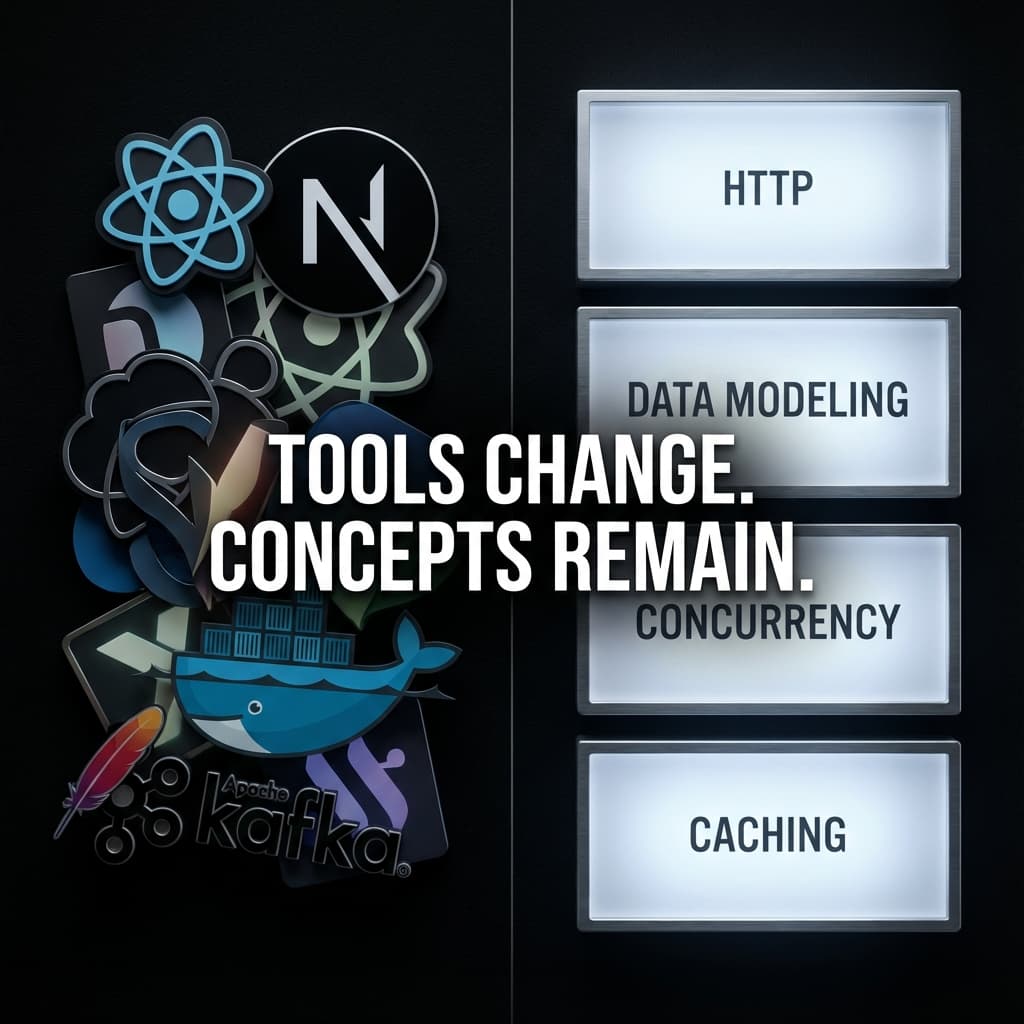
Tools are frameworks, libraries, languages, and platforms:
React, Next.js, Spring Boot, Docker, Kafka.
Concepts are the underlying ideas:
State management, request-response lifecycle, concurrency, caching, data modeling.
Tools change fast.
Concepts barely change at all.
Yet most developers invert their priorities.
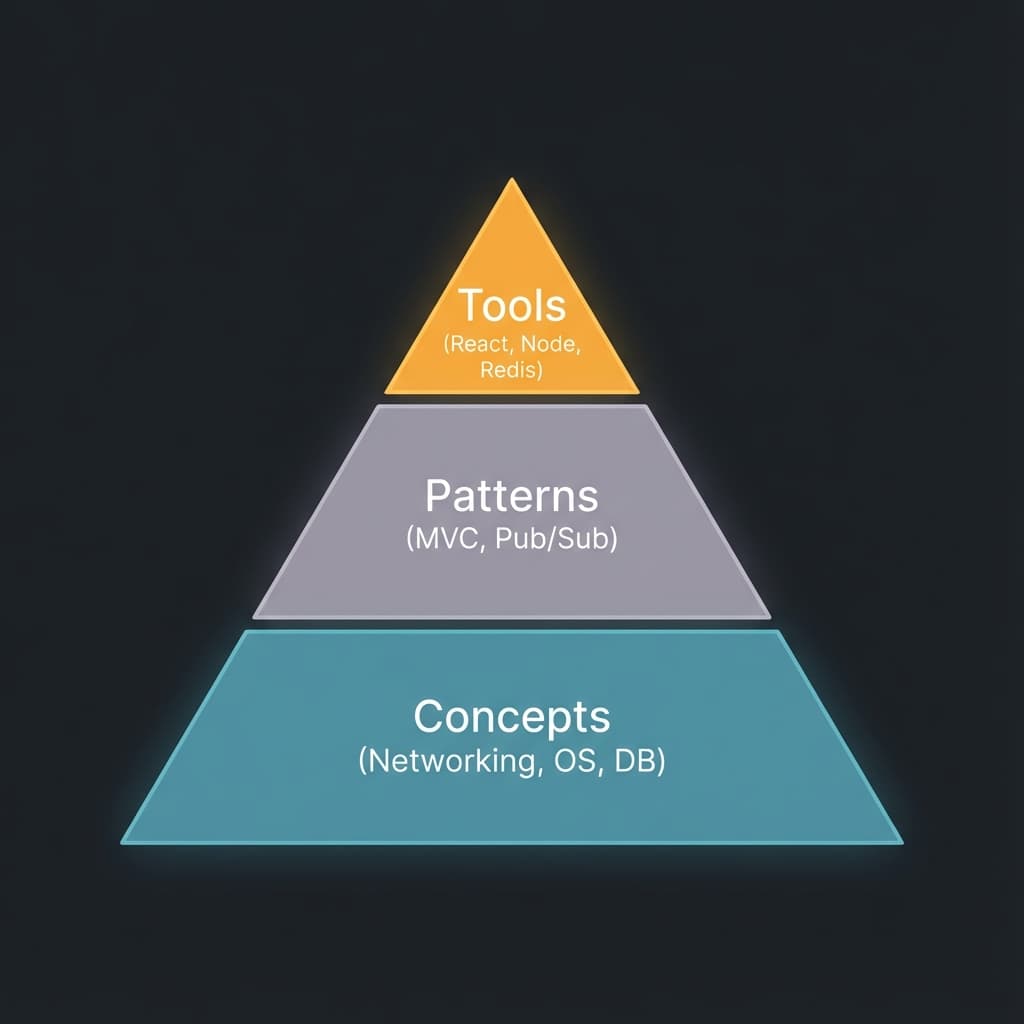
Why developers obsess over tools
Because:
- Job descriptions list tools, not concepts
- Tutorials market tools, not fundamentals
- Social media rewards speed, not depth
- Tools feel measurable (“learned X in 7 days”)
Concepts are harder. Slower. Less flashy.
So people avoid them.
That avoidance has a cost.
Concepts compound. Tools reset.
If you understand HTTP, any backend framework makes sense.
If you understand SQL and data modeling, databases are just implementations.
If you understand event loops, Node.js stops being magic.
If you understand caching strategies, Redis becomes obvious.
With concepts, learning a new tool takes days.
Without them, it takes months - and still fails in production.
A real backend example
A weak developer says:
“I know Express, NestJS, Fastify.”
A strong developer says:
“I understand request lifecycles, middleware chains, authentication flows, rate limiting, and caching.”
One breaks when the framework changes.
The other adapts instantly.
Same story in frontend, databases, and infrastructure.
What good interviews actually test
Strong interviewers don’t care if you’ve “used” a tool.
They ask:
- Why did you choose this approach?
- What breaks at scale?
- What are the trade-offs?
- How would you redesign this?
Those questions expose conceptual depth immediately.
No amount of tool-name-dropping saves you.
The correct balance
Ignoring tools is stupid.
Chasing only tools is worse.
Use this rule:
- Learn tools for employability
- Learn concepts for longevity
Tools get you interviews.
Concepts get you offers - and growth.
What to do instead
- For every tool you use, ask why it exists
- Study failures, not just “how to use”
- Read system design, not just documentation
- Rebuild features without frameworks at least once
- Optimize for understanding, not speed
If learning feels uncomfortable, you’re doing it right.
Final truth
Tools make you usable.
Concepts make you dangerous.
Most developers stay busy.
Very few become hard to replace.
Choose carefully.