Every few years, our industry discovers a new existential crisis.
Outsourcing. Low-code tools. No-code platforms. Bootcamps.
And now - AI.
The question echoes everywhere:
“Will AI replace software engineers?”
The honest answer is uncomfortable, but far more useful than reassurance:
AI will not replace software engineers. But it will absolutely replace parts of the job - and some engineers.
Let’s separate fear from reality.
The Illusion: “Software Engineering = Writing Code”
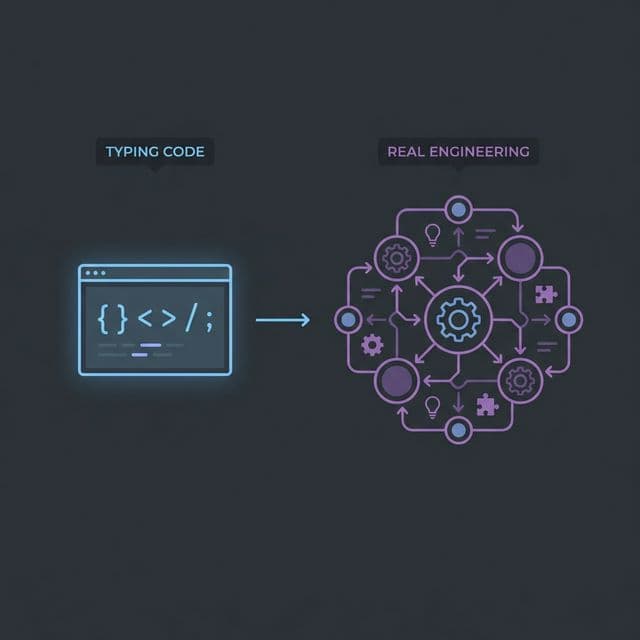
Most discussions about AI replacing developers start from a flawed assumption:
That writing code is the core value of a software engineer.
It never was.
Typing syntax has always been the easiest part of the job.
Real engineering has always been about:
- Understanding ambiguous problems
- Making tradeoffs under constraints
- Designing systems that survive failure
- Diagnosing non-obvious issues
- Managing complexity
- Owning decisions
Code is just the medium.
What AI Is Actually Exceptional At
AI is spectacular at patterned, mechanical, repeatable work:
✔ Generating boilerplate
✔ CRUD scaffolding
✔ Standard algorithms
✔ Known debugging patterns
✔ Syntax translation
✔ Documentation lookup
In other words:
AI eats effort.
Tasks that once took hours now take minutes.
This is not speculation. This is already happening.
What AI Is Fundamentally Bad At
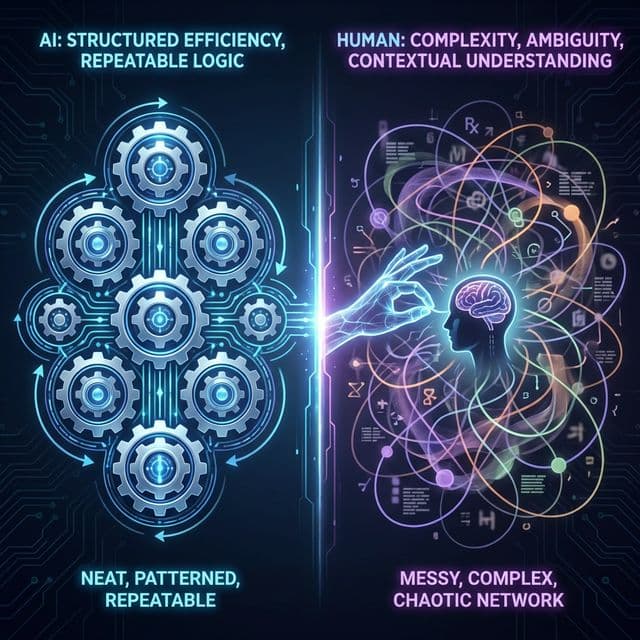
AI struggles where engineering becomes messy:
✔ Ambiguous requirements
✔ Contradictory constraints
✔ System-level tradeoffs
✔ Diagnosing weird production failures
✔ Performance bottlenecks
✔ Concurrency bugs
✔ Business judgment
✔ Accountability
AI produces answers.
Engineers own consequences.
That distinction matters more than most people realize.
The Uncomfortable Truth: Not All Engineers Are Equally Safe
AI is not a universal threat.
It is a selective pressure.
The engineers most vulnerable are not “developers” - but tool operators.
Engineers who primarily provide:
- Syntax knowledge
- Framework familiarity
- Boilerplate implementation
- Repetitive coding labor
AI commoditizes this value rapidly.
The Skill That Actually Determines Survival

There is one skill that dramatically increases long-term security:
Deep problem-solving through first-principles reasoning.
Not a language.
Not a framework.
Not “prompt engineering.”
The ability to look at a messy, unfamiliar problem and think clearly.
What This Looks Like in Practice
Average engineer thinking:
“The API is slow → Add caching.”
Strong problem solver thinking:
“Why slow?
Database latency? Lock contention? Network overhead?
Cache introduces consistency tradeoffs - is that acceptable?”
One reaction is mechanical.
The other is reasoning.
AI replaces mechanics far more easily than judgment.
Why Fundamentals Suddenly Matter More Than Ever
Ironically, AI increases the importance of fundamentals.
If AI writes large portions of your code, your value shifts to:
✔ Verifying correctness
✔ Identifying bad abstractions
✔ Detecting hidden edge cases
✔ Evaluating tradeoffs
✔ Recognizing failure modes
Without strong fundamentals, you cannot reliably judge AI output.
You become dependent on a system you cannot critically evaluate.
That is a fragile position.
Backend Engineering: A Case Study in AI Resistance
Consider modern backend systems:
Distributed services.
Concurrency.
State management.
Failure handling.
Consistency models.
Performance tuning.
These domains require reasoning about:
✔ Latency vs throughput
✔ Consistency vs availability
✔ Idempotency
✔ Race conditions
✔ Backpressure
✔ Scaling bottlenecks
✔ Data correctness
AI can generate code for queues and caches.
It cannot intuitively reason about emergent system behavior.
How Hiring Dynamics Are Quietly Shifting
Something subtle is happening.
Companies increasingly need:
✔ Smaller teams
✔ Higher skill density
✔ Faster execution
AI amplifies strong engineers.
It reduces the need for large teams of average ones.
This doesn’t eliminate opportunities - but it raises the bar.
Differentiation is moving from:
“Can you build features?”
to
“Can you reason about complex systems?”
The Real Industry Transition
Software engineering is slowly evolving from:
Code Production
to
Decision Making Under Complexity
AI accelerates this transition.
Syntax becomes cheaper.
Judgment becomes more valuable.
Final Reality Check
AI will:
✔ Replace repetitive coding effort
✔ Replace low-skill mechanical work
✔ Replace engineers who only provide implementation value
AI will not:
✔ Replace deep problem solvers
✔ Replace system-level thinkers
✔ Replace architectural judgment
✔ Replace accountability
The future does not belong to engineers who write the most code.
It belongs to engineers who think the best.
The Only Sensible Strategy
Stop asking:
“Will AI replace developers?”
Start asking:
“Am I developing skills AI struggles to replicate?”
Because tools change.
Abstractions change.
Languages change.
But the ability to reason clearly about problems never becomes obsolete.